
How 3D Printing is Transforming Drone Services

In the fast moving world of drone services, adaptability and innovation are what separate good operators from great ones. While most people think of drones in terms of cameras and flight performance, there is another powerful tool quietly reshaping what is possible behind the scenes: 3D printing.
At First Class Drones, integrating 3D printing into our workflow has allowed us to move faster, solve unique challenges, and create custom solutions that simply would not be possible with off the shelf components.

Customization Without Limits
Every drone project is different. Whether it is a construction monitoring job, a cinematic FPV shoot, or a custom drone solutions, there are always small technical challenges that require creative solutions.
3D printing allows us to design and produce custom parts tailored specifically to each job. Instead of trying to modify existing components or wait weeks for a manufacturer, we can prototype and produce parts in house within hours. This gives us a major advantage when timelines are tight and expectations are high.
Rapid Prototyping and Iteration
One of the biggest advantages of 3D printing is speed. Traditional manufacturing can be slow and expensive, especially for one off parts. With 3D printing, we can design, test, adjust, and reprint in the same day.
This rapid iteration process allows us to refine our designs quickly and ensure that every component performs exactly as needed before it ever reaches a client project.

Customizing Our Movi Systems
Beyond drones themselves, 3D printing has also played a major role in how we customize our Movi systems to better fit our needs on set.
We have developed a range of custom 3D printed components that allow us to modify mounting options, improve balance, and adapt quickly to different camera setups. This level of customization gives us more flexibility when switching between projects and helps us maintain efficiency without compromising performance.
Instead of being limited by standard configurations, we are able to build solutions that work specifically for our workflow, making our Movi setups more versatile and production ready.

Our Custom Quick Release System
A great example of practical innovation is the quick release system we developed for our drones and batteries.
Managing batteries efficiently on set is critical, especially during fast paced shoots where downtime can impact production. Using 3D printing, we created a custom quick release mechanism that allows for faster battery swaps while maintaining a secure connection during flight.
Building Advanced Drop Mechanisms
3D printing also opens the door to entirely new capabilities.
We are currently in the process of developing a new and improved drop mechanism designed for precision payload release. This builds on previous work, including a custom solution used during our work on Extracted, where we successfully executed a controlled drop as part of the production.
With this new design, we are focusing on improved reliability, cleaner release timing, and better integration across different drone platforms. Because we are designing and producing these components in house, we can tailor each version to meet very specific creative and technical requirements.
Cost Effective Innovation
Another key advantage of 3D printing is cost control. Custom machining or sourcing niche parts can be expensive, especially when multiple versions are needed. 3D printing significantly reduces these costs, allowing us to experiment and innovate without major financial risk.
This means we can invest more into refining our tools and delivering better results for our clients.
Staying Ahead in a Competitive Industry
The drone industry is evolving quickly, and staying competitive requires more than just skilled pilots and high end equipment. It requires the ability to solve problems creatively and adapt on the fly.
3D printing gives us that edge. It allows us to build solutions that are unique to our workflows, respond to challenges immediately, and continuously improve how we operate.
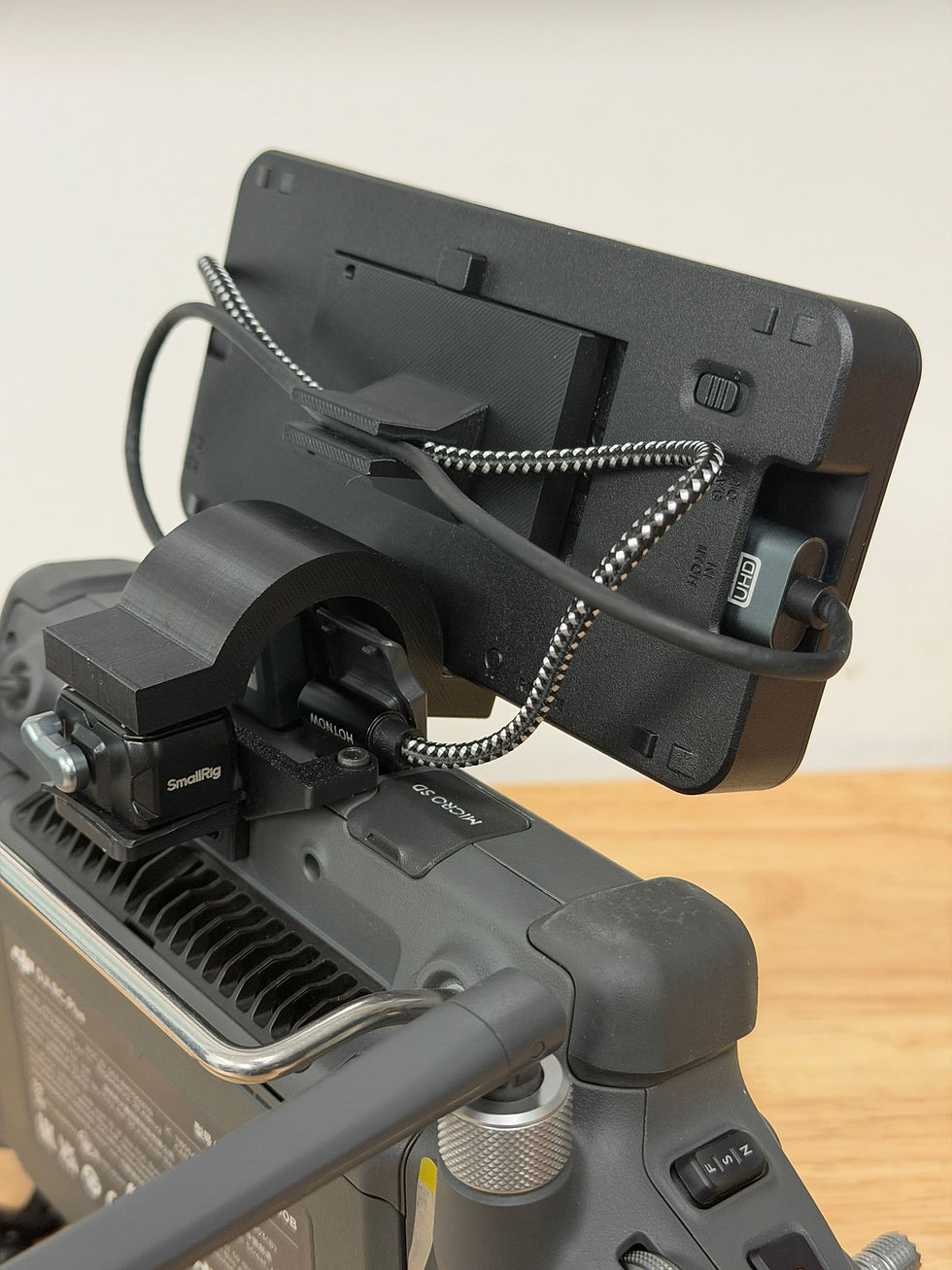
QR new More to come on this DJI Transmission Holder
Looking Ahead
As we continue to push the boundaries of what drones can do, 3D printing will remain a core part of our innovation process. From small efficiency upgrades like our quick release system to more advanced developments like our upcoming drop mechanism, the ability to design and build in house is changing how we approach every project.
For drone service companies looking to stand out, 3D printing is not just a nice tool to have. It is quickly becoming an essential part of the toolkit.

Blog written by:
David Polan
Director Of Business Development at First Class Drones
Bio:
David has been with First Class Drones for over six years, combining his passion for technology with a creative approach to aerial storytelling and business development. He has extensive experience piloting both traditional and FPV drones, bringing dynamic perspectives and cinematic precision to every project.
Today, David serves as Head of Business Development and Senior Pilot at First Class Drones. He is excited about the future of drone technology and looks forward to the innovative projects on the horizon for First Class Drones.


Comments