
Flying the ALTA X for Aerial Deliveries on Extracted Season 2
- David Polan

- Feb 24
- 4 min read
Not every drone job is about videography, photography, inspection or mapping. Some projects push creativity, precision, and piloting skill to the limit.
For Extracted Season 2, First Class Drones was brought in to handle one of the most unique challenges we have worked on to date: aerial delivery of supply crates to contestants in remote forest locations using our Freefly ALTA X.
The Challenge
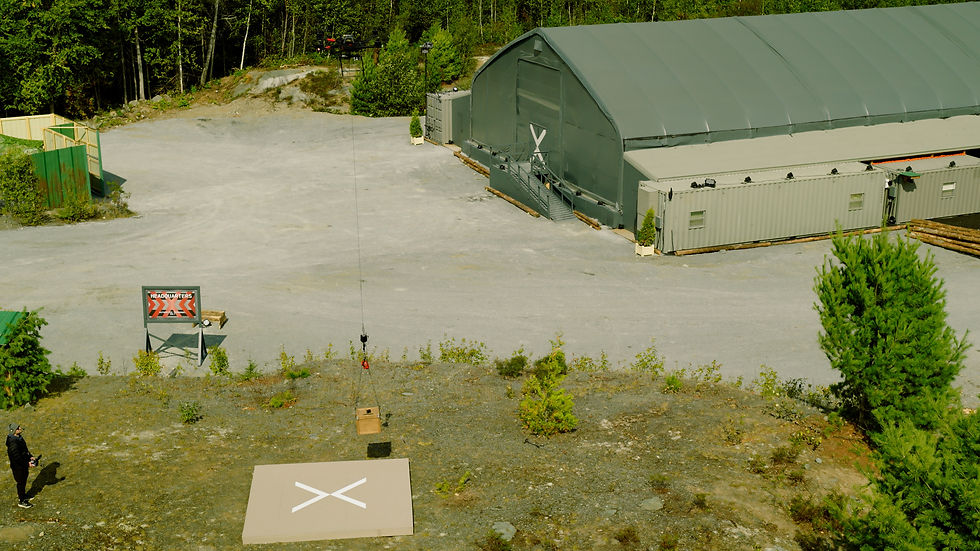
The concept was simple on paper but complex in execution. Contestants were positioned at specific locations deep in the forest. Our role was to fly supply crates from a central launch point and deliver them accurately to designated drop zones for retrieval.
There were no roads, no clearings, and no room for error.
Each flight required:
• Precise navigation through forested terrain
• Stable flight with a suspended payload
• Controlled aerial release
• Accurate placement of the crate within a defined landing area
Operating From the Forest
Unlike typical operations where takeoff happens from a clear, open area, we launched directly from the middle of the forest.
This introduced several technical considerations including take off clearance, uneven ground, and the production team all around. Takeoff and landing zones were carefully selected to maximize vertical clearance and maintain stable signal.
Before each flight, our team conducted:
• Detailed site surveys and obstacle assessments
• Compass and sensor verification
• Payload system testing
• Emergency procedure reviews
The ALTA X was brought up to lift smoothly and deliberately, allowing the payload to settle before transitioning into forward flight. This minimized oscillation and ensured a controlled climb through the trees.
Every variable was assessed and accounted for before committing to each flight.

Quick Release Delivery System
A critical component of this operation was the quick release mechanism used to deploy the crates safely and accurately. The system was integrated into the payload mounting assembly and tested extensively prior to production.
Before each flight, the release was dry tested on the ground to confirm proper engagement and activation. In the air, the aircraft was stabilized in a hover directly over the drop zone before the quick release was triggered. When activated, the mechanism allowed the crate to separate cleanly without contacting the landing gear or affecting aircraft stability.
To increase accuracy, we utilized a downward facing camera to visually confirm the exact drop position before activating the release. This provided real time confirmation of ground conditions, clearance, and target alignment.
In addition, we monitored our precise aircraft positioning through Ground Station, allowing us to verify exact coordinates, altitude, and hover stability prior to deployment. Combining live visual feedback with telemetry data ensured each drop was executed with a high degree of spatial accuracy.
This integrated approach ensured consistent, repeatable drops while maintaining full control of the aircraft throughout the delivery process.
Precision Payload Aerial Delivery
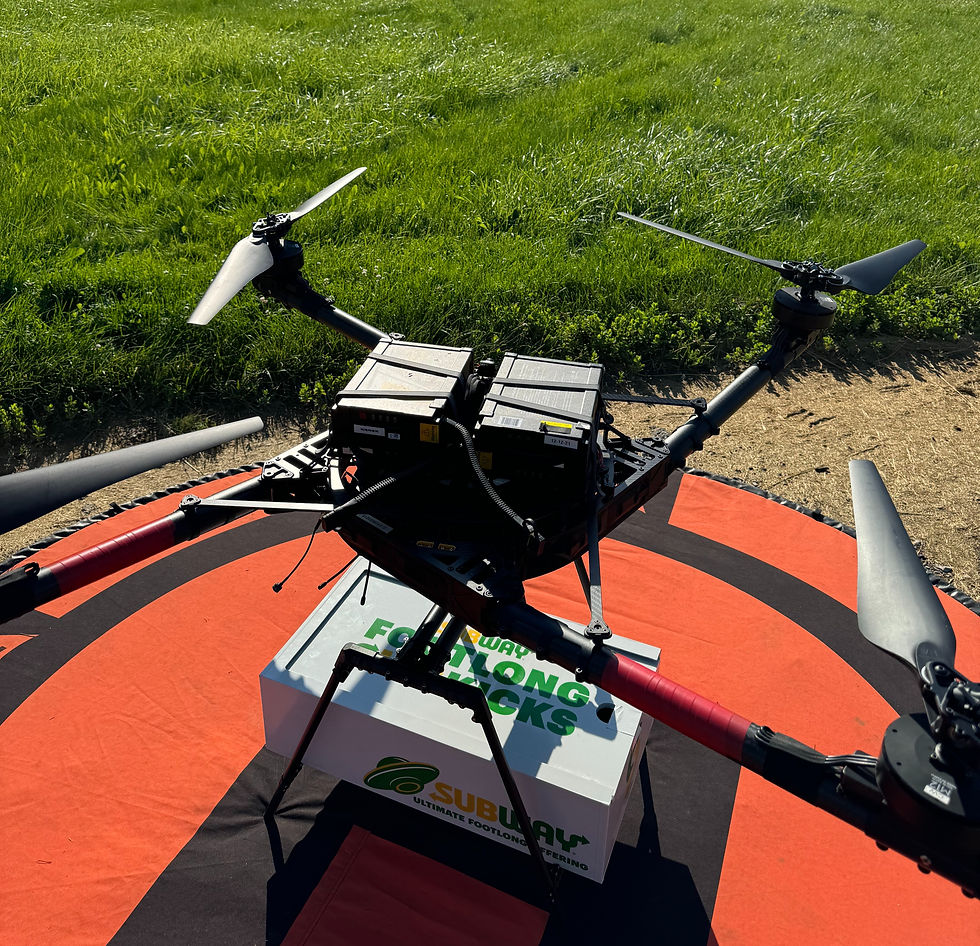
Each crate was securely attached beneath the ALTA X using a dedicated payload mounting system and remote controlled release mechanism. Payload weight, centre of gravity, and attachment geometry were carefully calculated to maintain stable flight characteristics.
Prior to flight, we performed:
• Payload weight verification
• Redundancy inspections on the release system
• Thrust margin calculations to account for dynamic load changes
Once airborne, we monitored the altitude and wind in real time. We waited for the aircraft to steady itself directly over the target before releasing the crate, ensuring a straight drop and a pinpoint landing.
At the drop location, altitude, airspeed, and wind conditions were assessed in real time. The crate was released only once the aircraft was stabilized directly over the intended drop zone, ensuring a predictable vertical descent and accurate landing within the defined retrieval area.
This process required constant communication and disciplined piloting.
Why the ALTA X Was the Right Tool
The Freefly ALTA X is purpose built for demanding professional operations involving heavy lift and complex flight profiles. Its design provided the reliability and control required for repeated aerial delivery missions in remote environments.
Key technical advantages included:
• High thrust to weight ratio, allowing safe operation with external payloads
• Large propellers providing efficient lift and smoother control response
• Redundant flight systems for increased operational safety
• Precise low speed handling for confined and obstacle rich environments
These capabilities allowed us to execute multiple delivery flights consistently and safely throughout production.
Supporting High End Television Production
Working on Extracted Season 2 required coordination with production crews, safety teams, and field staff. Every flight was carefully planned to meet creative goals while maintaining strict safety standards.
Aerial delivery added a powerful visual and storytelling element to the show, while allowing production to operate efficiently in difficult terrain.

More Than Just Flying
Projects like this highlight what professional drone operations can achieve beyond traditional use cases. From payload delivery to complex logistics, drones like the ALTA X open new possibilities when operated by experienced teams.
At First Class Drones, we specialize in high precision, high responsibility drone work for film, television, and industrial applications.
If your production requires advanced aerial capabilities, we are ready to take on the challenge.
Blog written by:

David Polan
Director Of Business Development at First Class Drones
Bio:
David has been with First Class Drones for over six years, combining his passion for technology with a creative approach to aerial storytelling and business development. He has extensive experience piloting both traditional and FPV drones, bringing dynamic perspectives and cinematic precision to every project.
Today, David serves as Head of Business Development and Senior Pilot at First Class Drones. He is excited about the future of drone technology and looks forward to the innovative projects on the horizon for First Class Drones.
Comments